ProActive Chiropractic is a sports chiropractic practice in downtown San Francisco built for the kind of athlete Hyrox attracts: high-functioning, self-directed, training hard, and unwilling to lose a season to a nagging injury nobody has explained. Eight runs, eight stations, sixty to ninety minutes of accumulating fatigue. The format finds your weakest link and presses on it. Our job is to find it first, and fix what is actually driving it.
Hyrox is a chain. It breaks at the weak link, not the strong one.
The race does something most training never does: it loads your entire kinetic chain, repeatedly, while you are too tired to compensate cleanly. That is not a flaw in the event; it is the whole point of it. And it is why the thing that finally hurts is almost never the thing that is actually wrong.
The wall-ball shoulder that lights up at rep 70 was set up by an upper back that stopped rotating months ago. The low back that seizes on the sled was carrying for hips that do not extend. Hyrox does not create these patterns; it exposes them.

Treat the station that hurts and you will be back in the same spot next block. Find the pattern feeding it and the station stops being the problem. The site of the symptom is rarely the source.
What breaks, station by station
Athletes do not describe a "Hyrox injury." They describe a station and a symptom: a shoulder after wall balls, a back after the sled, a calf that will not settle. Here is the map, in race order. The later stations land on an already-cooked body, which is part of why they injure people.
Shoulders and lats, as the upper back rounds and you pull overhead under fatigue.
Lower back, when stiff hips and quiet glutes hand the load to the spine. Quads and calves too.
Lower back and shoulder, plus grip; scapular control fades and the rotator cuff takes over.
Knees and calves on the landing; lower back and shoulders on the drop to the floor.
Lower back, from repeated lumbar flexion once the core stops bracing late in the piece.
Grip, forearm, and elbow; the core and traps when the carry runs long under fatigue.
Knees and hips, loaded single-leg, late, when one side quietly starts to cheat.
Shoulders from high-volume overhead; knees from the squat count; the thoracic spine.
The pattern across all of it: roughly four in ten Hyrox athletes report a training or racing injury, and the large majority are overuse, not accidents. The most common are tendinopathies, particularly the Achilles, the knee, and the rotator cuff. Overuse injuries are predictable. Predictable means findable. Findable means we can get ahead of them.
The five that send people to us
Lower back (sled push, sled pull, farmers carry, rowing). The most common complaint, and rarely a back problem. The sled asks for force through the posterior chain with the spine under load; when the hips are stiff or the glutes are slow, the lumbar spine absorbs what they will not. The fix is not a stronger back; it is getting the hips and glutes to do their job so the back stops volunteering.
Knees and hips (sandbag lunges, running, wall balls). Loaded single-leg work, late in the race, on legs that have already run kilometers. This is where asymmetries you can hide in bilateral training get exposed: one side does more, and the knee or hip pays for it. Runner's knee and hip irritation are the usual signatures.
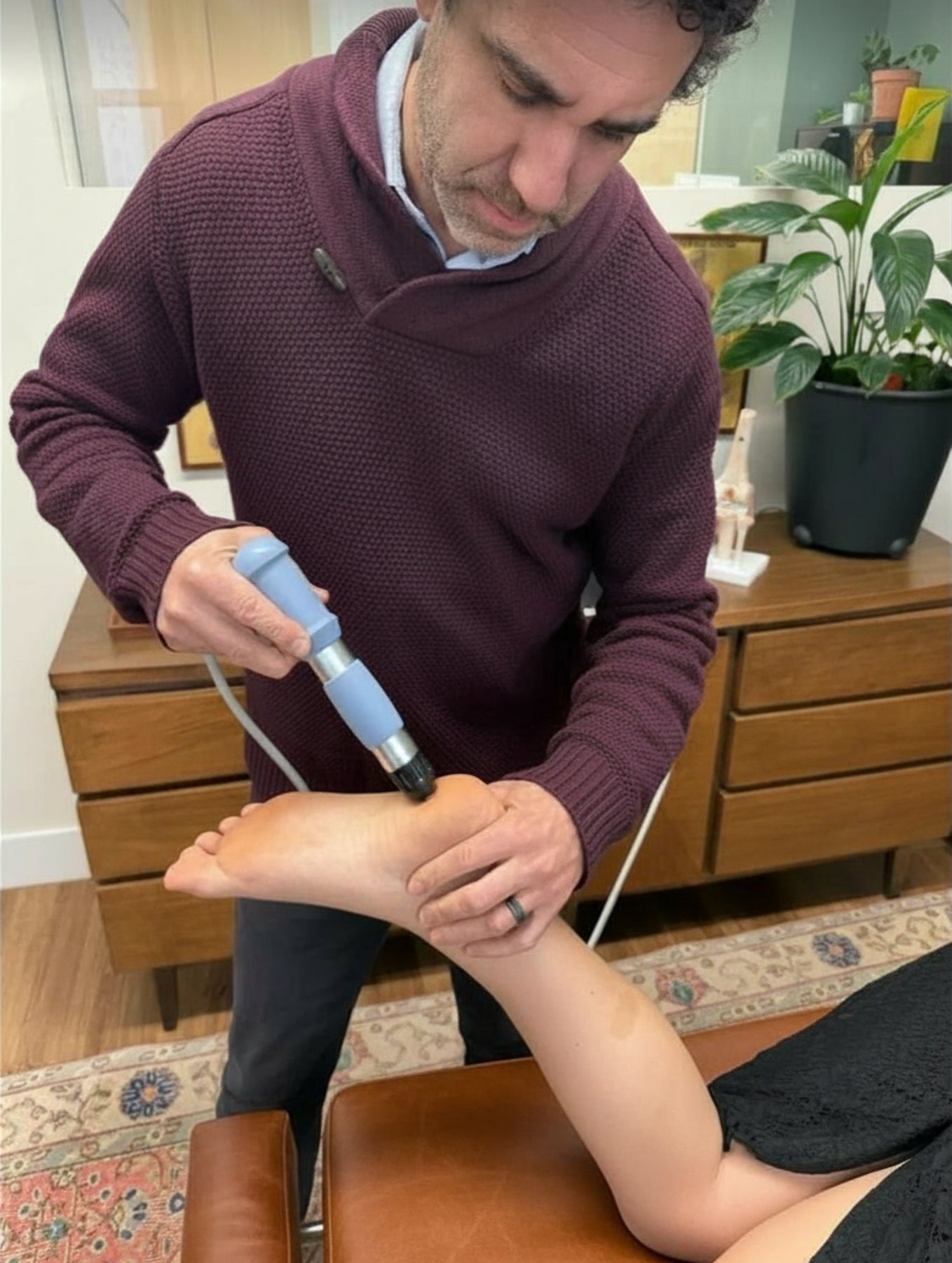
Achilles and calf (sled push, running volume). Eight kilometers of running stacked on sled work and explosive landings, often after a recent jump in mileage. These are textbook overuse injuries, which means they whisper before they shout. For stubborn calf and Achilles tendinopathy, shockwave therapy targets the tendon's capacity to remodel rather than just muting the pain on top of it.

Shoulder and rotator cuff (SkiErg, wall balls, sled pull). High-volume overhead and pulling reps under fatigue, with a rounding upper back. By the back half of the set, scapular control is gone and the cuff is taking load it was never meant to carry alone. The shoulder is where it shows; the thoracic spine and shoulder blade are usually where it starts.
Plantar fascia and feet (running volume). The feet take the full eight kilometers plus every transition. Plantar fascia irritation is one of the most common and most ignored complaints in the sport, and another that responds well to shockwave when it has become chronic. When the driver is how the foot is loading under that volume, custom orthotics address the mechanics shockwave alone doesn't touch.
The one nobody is writing about
Grip, forearm, and elbow (farmers carry, sled pull). Sustained heavy carries and pulls under fatigue load the grip and forearm in ways most training does not, and forearm tendinopathy and elbow irritation follow. Most Hyrox content skips it entirely. Often the real driver is upstream, at the shoulder, and the elbow is simply where the chain gave. If your grip is failing before your legs do, that is a signal worth reading, not just training around.
Why rest alone does not fix it
Rest quiets a symptom; it does not fix the pattern that is still running underneath. Most Hyrox athletes are not going to stop training, and they should not have to in order to get this addressed. The work starts with a Body Intelligence Assessment™: a full read of how you actually move and load, so we find the link, not just the lesion. From there, Systems-Based Bodywork™ to free what is stuck and retrain what is compensating, plus shockwave for the tendon and fascia injuries Hyrox specializes in producing.
This is the same standard Dr. Cohen built working with elite athletes, applied to an everyday hybrid-fitness body. The population changes; the method does not. If you also run outside of Hyrox, the running-injury page covers the overlap, and the sports chiropractic overview covers the rest.
Built for the rooms you train in
ProActive is in downtown San Francisco, a short hop from where most of the city's Hyrox prep actually happens: CrossFit South Park in SoMa, CrossFit Golden Gate on Van Ness, and CrossFit Alinea. If you are training for an SF race out of any of them, you are close. The same goes for the Financial District and SoMa crowd fitting training in before or after work, and the East Bay and Peninsula athletes who already commute in on BART.
The diagnostic standard
Dr. Andrew Cohen, DC, CCSP® is a Certified Chiropractic Sports Physician with 20+ years of clinical experience. His diagnostic framework was built at three U.S. Olympic Training Centers, at the U.S. Olympic Team Trials in track and field, and at endurance events including the Western States 100. That framework, the Body Intelligence Assessment™, is what every athlete gets, whether you are chasing a podium time or finishing your first race upright.
Most musculoskeletal problems that do not resolve have a pattern driving them that has not been identified. The site of pain is rarely the source of the problem. That is the whole job: find the mechanism, not just the location.
You will leave your first visit feeling seen, heard, and hopeful. Not a sales line; we back it. If that is not your experience, we will refund your first visit in full.